
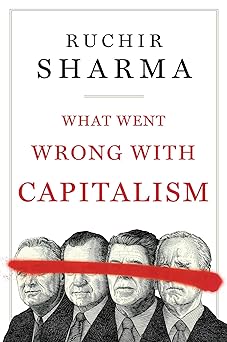
What Went Wrong with Capitalism book by Ruchir Sharma
What Went Wrong with Capitalism book by Ruchir Sharma
A century of expanding government has distorted financial markets, stoked massive inequality, and soaked America in debt.
What went wrong with capitalism? Ruchir Sharma’s explanation is unlike any you will have heard before. Progressives are partly right when they mock modern capitalism as “socialism for the rich,” but what really happened in recent decades is that the government expanded in just about every measurable dimension, from spending and regulation to the sheer scale of its rescues each time the economy wobbled. The result, Sharma says, is “socialized risk,” expensive government guarantees, for everyone—welfare for the poor, entitlements for the middle class, and bailouts for the rich.
The Reagan and Thatcher Revolution of the 1980s did little to reverse this trend; it just changed the way governments finance themselves. They now rely more on borrowing than taxing. Over the last forty years, governments and central banks have pumped so much money into the economy that the markets can no longer allocate capital efficiently. Capitalism is now so deeply addicted to debt, even the return of inflation in recent years—which ended four decades of easy money—has not weaned its leaders off their habit. Many high-profile symbols of capitalism gone wrong, including the rise of monopolies and billionaires, are effectively creatures of a borrow and bailout culture. They thrive in a system soaked in too much government support. Conservatives and liberals find themselves surprisingly united in support of bigger government, whether to fight climate change, to revive manufacturing, to out-compete China, or contain Russia. President Biden is leading the way and has put the United States on course to become the developed world’s biggest deficit spender and biggest debtor.
Voters say they are disillusioned with capitalism, but a system so distorted by government interventions is a dysfunctional version of free market ideals. As a result, productivity and economic growth have slowed sharply, shrinking the pie for everyone, and stoking popular anger. Since these flaws developed as the government expanded, building an even bigger state will only double down on what’s gone wrong. The answer Sharma offers is a series of seven fixes to restore the balance between state support and economic freedom and lay the path to a happier future.
Book Specifications
About Ruchir Sharma
View full author profile →
Book Title
You are viewing an alternative format/edition for this title. You can proceed directly to this book's page to complete your purchase.
More Books By Ruchir Sharma

Breakout Nations: In Pursuit of the Next Economic Miracles book by Ruchir Sharma
People who bought this also bought
Bringing Words to Life: Robust Vocabulary Instruction book by Isabel L. Beck
The E-Myth Attorney: Why Most Legal Practices Don't Work and What to Do About It book by Michael E. Gerber
Influence is Your Superpower: How to Get What You Want Without Compromising Who You Are book by Zoe Chance
Leading With Questions: How Leaders Find the Right Solutions by Knowing What to Ask book by Michael J. Marquardt
Life of David (Solid Foundation Sermon Starters) Book By Steve Jones
Fair Shot: Rethinking Inequality and How We Earn book by Chris Hughes
Living a Life of Awareness: Daily Meditations on the Toltec Path book by Miguel Ruiz Jr.
Jewtopia: The Chosen Book for the Chosen People book by Bryan Fogel
Eucharist: Celebrating Its Rhythms in Our Lives book by Paul Bernier
Good News for Modern Man: Today's English Version of the New Testament
Beyond Good and Evil: Prelude to a Philosophy of the Future book by Friedrich Nietzsche
In Defense of Food: An Eater's Manifesto book by Michael Pollan
Jab, Jab, Jab, Right Hook: How to Tell Your Story in a Noisy Social World
Hacking Growth: How Today's Fastest-Growing Companies Drive Breakout Success book by Sean Ellis , Morgan Brown