
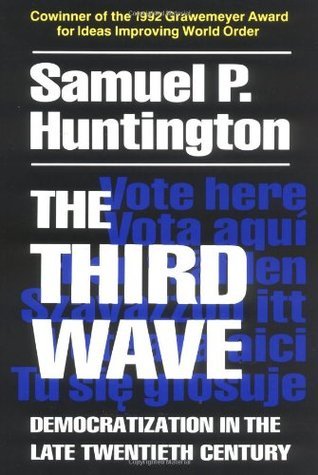
The Third Wave: Democratization in the Late Twentieth Century book by Samuel P. Huntington
The Third Wave: Democratization in the Late Twentieth Century book by Samuel P. Huntington
Between 1974 and 1990 more than thirty countries in southern Europe, Latin America, East Asia, and Eastern Europe shifted from authoritarian to democratic systems of government. This global democratic revolution is probably the most important political trend in the late twentieth century. In The Third Wave, Samuel P. Huntington analyzes the causes and nature of these democratic transitions, evaluates the prospects for stability of the new democracies, and explores the possibility of more countries becoming democratic. The recent transitions, he argues, are the third major wave of democratization in the modem world. Each of the two previous waves was followed by a reverse wave in which some countries shifted back to authoritarian government. Using concrete examples, empirical evidence, and insightful analysis, Huntington provides neither a theory nor a history of the third wave, but an explanation of why and how it occurred. Factors responsible for the democratic trend include the legitimacy dilemmas of authoritarian regimes; economic and social development; the changed role of the Catholic Church; the impact of the United States, the European Community, and the Soviet Union; and the "snowballing" phenomenon: change in one country stimulating change in others. Five key elite groups within and outside the nondemocratic regime played roles in shaping the various ways democratization occurred. Compromise was key to all democratizations, and elections and nonviolent tactics also were central. New democracies must deal with the "torturer problem" and the "praetorian problem" and attempt to develop democratic values and processes. Disillusionment with democracy, Huntington argues, is necessary to consolidating democracy. He concludes the book with an analysis of the political, economic, and cultural factors that will decide whether or not the third wave continues. Several "Guidelines for Democratizers" offer specific, practical suggestions for initiating and carrying out reform. Huntington's emphasis on practical application makes this book a valuable tool for anyone engaged in the democratization process. At this volatile time in history, Huntington's assessment of the processes of democratization is indispensable to understanding the future of democracy in the world. Published By University of Oklahoma Press on 1993-01-01
Book Specifications
Book Title
You are viewing an alternative format/edition for this title. You can proceed directly to this book's page to complete your purchase.
More Books By Samuel P. Huntington

The Third Wave: Democratization in the Late Twentieth Century book by Samuel P. Huntington
The Clash of Civilizations and the Remaking of World Order book by Samuel P. Huntington
People who bought this also bought
Brothers at War: Making Sense of the Eritrean-Ethiopian War (Eastern African Studies) book by Tekaste Negash
Conversations with God: An Uncommon Dialogue Guide book by Neale Donald Walsch
You've Got This: Seven Steps to a Life You Love book by Michaela Dunbar
I Dared to Call Him Father: The Miraculous Story of a Muslim Woman's Encounter with God book by Bilquis Sheikh
Memory'S Ghost: The Nature Of Memory And The Strange Tale Of Mr. M
The New Arab Wars: Uprisings and Anarchy in the Middle East book by Marc Lynch
The Corporate Athlete: How to Achieve Maximal Performance in Business and Life book by Jack L. Groppel
Good to Great: Why Some Companies Make the Leap... and Others Don't book by Jim Collins
Identity: The Demand for Dignity and the Politics of Resentment book by Francis Fukuyama
Surrounded by Psychopaths : or, How to Stop Being Exploited by Others
How to Be an Adult in Relationships: The Five Keys to Mindful Loving book by David Richo
Waste: Uncovering the Global Food Scandal book by Tristram Stuart
Secrets to Winning at Office Politics book by Marie G. McIntyre
Guns, Germs, and Steel: The Fates of Human Societies book by Jared Diamond
All I Really Need to Know I Learned in Kindergarten book by Robert Fulghum
Oversubscribed: How To Get People Lining Up To Do Business With You book by Daniel Priestley
The HR Scorecard: Linking People, Strategy, and Performance book by Dave Ulrich
The Undercover Economist Strikes Back: How to Run-or Ruin-an Economy book by Tim Harford