
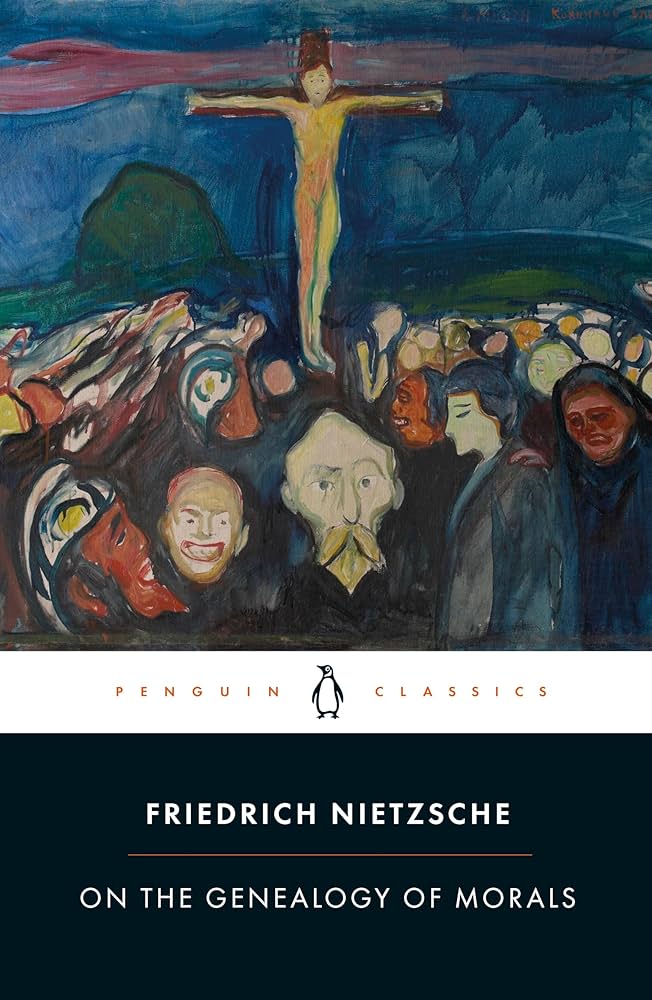
On the Genealogy of Morals book by Friedrich Nietzsche
The companion book to Beyond Good and Evil, the three essays included here offer vital insights into Nietzsche's theories of morality and human psychology.
Nietzsche claimed that the purpose of The Genealogy of Morals was to call attention to his previous writings. But in fact the book does much more than that, elucidating and expanding on the cryptic aphorisms of Beyond Good and Evil and signalling a return to the essay form. In these three essays, Nietzsche considers the development of ideas of 'good' and 'evil'; explores notions of guilt and bad consience; and discusses ascetic ideals and the purpose of the philosopher. Together, they form a coherent and complex discussion of morality in a work that is more accessible than some of Nietzsche's previous writings.
Friedrich Nietzsche was born near Leipzig in 1844. When he was only twenty-four he was appointed to the chair of classical philology at Basel University. From 1880, however, he divorced himself from everyday life and lived mainly abroad. Works published in the 1880s include The Gay Science, Thus Spoke Zarathustra, Beyond Good and Evil, On the Genealogy of Morals, Twilight of the Idols and The Antichrist. In January 1889, Nietzsche collapsed on a street in Turin and was subsequently institutionalized, spending the rest of his life in a condition of mental and physical paralysis. Works published after his death in 1900 include Will to Power, based on his notebooks, and Ecce Homo, his autobiography.
Michael A. Scarpitti is an independent scholar of philosophy whose principal interests include English and German thought of the eighteenth and nineteenth centuries, as well as exegesis and translation theory.
Robert C. Holub is currently Ohio Eminent Scholar and Professor of German at the Ohio State University. Among his published works are monographs on Heinrich Heine, German realism, Friedrich Nietzsche, literary and aesthetic theory, and Jurgen Habermas.
Book Specifications
About Friedrich Nietzsche
born in röcken bei lützen, prussian province of saxony, germanyoctober 15, 1844died august 25, 1900genre : philosophy, psychology, artinfluences:
View full author profile →
Book Title
You are viewing an alternative format/edition for this title. You can proceed directly to this book's page to complete your purchase.
More Books By Friedrich Nietzsche

Ecce Homo: How One Becomes What One Is book by Friedrich Nietzsche
Human, All Too Human: A Book for Free Spirits book by Friedrich Nietzsche
Beyond Good and Evil: Prelude to a Philosophy of the Future book by Friedrich Nietzsche
Beyond Good and Evil: Prelude to a Philosophy of the Future book by Friedrich Nietzsche
People who bought this also bought
The Earth and Its Peoples: A Global History book by Richard Bulliet
The Inevitable: Understanding the 12 Technological Forces That Will Shape Our Future book by Kevin Kelly
Non-Bullshit Innovation: Radical Ideas from the World?s Smartest Minds book by John A. Byrne
Invisible Women: Exposing Data Bias in a World Designed for Men book by Caroline Criado Pérez
The Aladdin Factor: How to Ask for What You Want--and Get It book by Jack Canfield
The Power of Babel: A Natural History of Language book by John McWhorter
Rigged: How the Media, Big Tech, and the Democrats Seized Our Elections book by Mollie Hemingway
Pershing's Lieutenants: American Military Leadership in World War I book by David T. Zabecki
Get Your Sh*t Together: The New York Times Bestseller book by Sarah Knight
The Feather Thief: Beauty, Obsession, and the Natural History Heist of the Century book by Kirk Wallace Johnson
The Conscious Parent's Guide to Childhood Anxiety book by Sherianna Boyle
Tough-Minded Faith for Tender-Hearted People book by Robert H. Schuller
Peoplewatching: The Desmond Morris Guide to Body Language book by Desmond Morris