
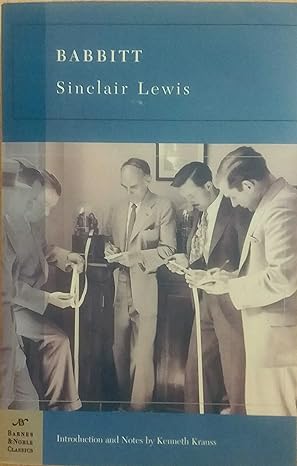
Babbitt book by Sinclair Lewis(Barnes & Noble Classics Series)
By Sinclair LewisBabbitt book by Sinclair Lewis(Barnes & Noble Classics Series
In his novel Babbitt, Sinclair Lewis took a close look at what America was fast becoming and described it in clear, often damningly accurate and hilarious detail. In the 1920s, when readers first encountered the novel, they glimpsed new trends and tendencies that were going on all around them; we, as readers, today are in the curious position of witnessing just when and how the world as we know it—the world that we see virtually everywhere and that we tend to take for granted—came into being.
The hero, or at least main character, of the book is hardly unusual. He is distinguished by neither intelligence nor stupidity, bravery nor cowardice, kindness nor cruelty. Although he manages to demonstrate all of these characteristics, none of them can quite characterize him. In fact, George F. Babbitt is most interesting because he is not interesting, because he manages to locate himself between the extremes, positioning himself resolutely in the middle. He is, to put it simply, a middle-class, middle-brow, middle-aged, middle-American male who is about to embark on a midlife crisis. As a resident of the middle-sized Midwestern city of Zenith in 1920, he is poised on the brink of a great boom in the American economy and all the daring social changes that came along with it.
Yet as a person of some (although it must be stressed, just some) feeling, moral conscience, and spiritual belief, he is also heir to the terrible disillusionment that followed the Great War (World War I), which, in fact, is directly mentioned only once in the book. Babbitt may not have participated in the “war to end all wars,” but his experience of his world makes clear in subtle ways just how America was struggling to redefine and, at the same time, to remain itself after the cataclysm. Babbitt, who was (and probably still is) regarded by many as a (if not the) quintessential American type, stands at the center of a culture that, to borrow from Charles de Gaulle, had gone from barbarism to decadence without the usual intervening phase of civilization.
George F. Babbitt may not be a very likeable character, but he is difficult to hate completely. Ultimately, like some, but not all, of the people who inhabit Sinclair Lewis’s fiction, he makes his peace with his times by choosing to go along with them and with all that he has previously questioned. The notion of conformism, which Babbitt at times praises and at other times ridicules, plays a powerful role in the way he lives his life. One may not wish to be exactly like everyone else, but at the same time, one cannot afford to be too different. The pressure of others is inescapable in the end.
Nevertheless, perhaps his very lack of anything outstanding, whether for good or ill, makes Babbitt a genuinely outstanding modernist creation. Babbitt functions in literature as most people appear to function in life: He blends in, goes along, tries to uphold what is generally thought to be best for himself and perhaps his family and, at the same time, strives to make a buck. This blend of business not with pleasure but with what is supposed to be decency (which is never much fun) is an uneasy one. During the course of the narrative, Babbitt strays, questions his own misgivings, looks to end his own unhappiness, and rebels. In the end, he makes amends. Unwilling to accept the peril that comes with rebellion, Babbitt cautiously, but gratefully, interjects himself back into the social matrix that he has come so close to despising. He is saved at the expense of being lost.
Book details
- Paperback
- 368 pages
- English
- 1593082673
- 9781593082673
About Sinclair Lewis
sinclair lewis was Read More about Sinclair Lewis
More Books By Sinclair Lewis

Babbitt book by Sinclair Lewis(Barnes & Noble Classics Series)
People who bought this also bought
Greenspan's Bubbles: The Age of Ignorance at the Federal Reserve book by William Fleckenstein
Prayers for a Planetary Pilgrim: A Personal Manual for Prayer and Ritual
One World, Many Religions: The Ways We Worship book by Mary Pope Osborne
Herding Tigers: Be the Leader That Creative People Need book by Todd Henry
Superlative: The Biology of Extremes book by Matthew D. LaPlante
Millionaire Success Habits: The Gateway to Wealth and Prosperity book by Dean Graziosi
The Book on Flipping Houses: How to Buy, Rehab, and Resell Residential Properties book by J. Scott
Sell or Be Sold: How to Get Your Way in Business and in Life book by Grant Cardone
Women and the Informal Economy in Urban Africa book by Mary Njeri Kinyanjui
Further Along the Road Less Traveled: The Unending Journey Toward Spiritual Growth book by M. Scott Peck
Clinical Ophthalmology: A Systematic Approach book by Jack J. Kanski
Youtility: Why Smart Marketing Is about Help Not Hype book by Jay Baer
Quiet: The Power of Introverts in a World That Can't Stop Talking book by Susan Cain
The Intelligent Investor Revised Edition : The Definitive Book on Value Investing by Benjamin Graham