
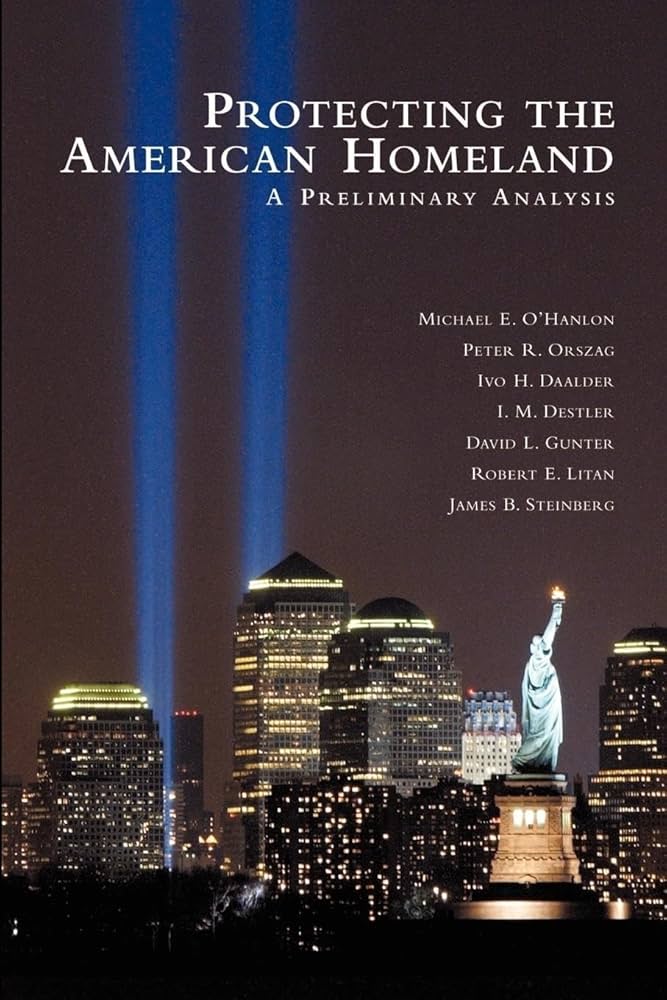
Protecting the American Homeland
The September 11 attacks forcefully brought home the need to better protect the U.S. homeland. But how can this be accomplished most effectively? Here, a team of Brookings scholars offers a four-tier plan to guide and bolster the efforts under way by the Bush administration and Congress.
There has been some progress in making our homeland more secure. But the authors are concerned that the Bush administration may focus too narrowly on preventing attacks like those of the recent past and believe a broader and more structured approach to ensuring homeland security is needed. Given the vulnerability of our open society, the authors recommend four clear lines of direction. The first and last have received a good deal of attention from the Bush administration, though not yet enough; for the other two, a great deal remains to be done:
- Perimeter defense at the border to prevent entry by potential perpetrators and the weapons and hazardous materials they may use
- Prevention by detecting possible terrorists within the United States and securing dangerous materials they might obtain here
- Identification and defense of key sites within the county: population centers, critical economic assets and infrastructure, and locations of key political or symbolic importance
- Consequence management to give those directly involved in responding to an attack that may nevertheless occur the tools necessary to quickly identify and attack and limit its damage
Included are specific recommendations on how much more to spend on homeland security, how much of the cost should be borne by the private sector, and how to structure the federal government to make the responsible agencies more efficient in addressing security concerns. Specifically, the authors believe that annual federal spending on homeland security may need to grow to about $45 billion, relative to a 2001 level of less than $20 billion and a Bush administration proposed budget for 2003 of $38 billion. They also discuss what burden state, local, and private-sector actors should bear in the overall national effort. Finally, the authors conclude that rather than creating a homeland security superagency, Tom Ridge, the director of the Office of Homeland Security, should have enhanced authority.
Book Specifications
About Michael E. O'Hanlon
michael edward o'hanlon (born may 16, 1961) is a senior fellow at the brookings institution, specializing in defense and foreign policy issues. he began hi
View full author profile →
Book Title
You are viewing an alternative format/edition for this title. You can proceed directly to this book's page to complete your purchase.
More Books By Michael E. O'Hanlon
People who bought this also bought
![Riri Na Mavuku Ma deuterokaniko [Kiembu-Kimbeere Bible ]](http://atticbooks.co.ke/images/loading.svg)
The Handwriting of God: Sacred Mysteries of the Bible book by Grant R. Jeffrey
Mouth Full of Blood: Essays, Speeches, Meditations book by Toni Morrison
All I Really Need to Know I Learned in Kindergarten book by Robert Fulghum
Go Put Your Strengths to Work: 6 Powerful Steps to Achieve Outstanding Performance book by Marcus Buckingham
The Four Lenses of Innovation: A Power Tool for Creative Thinking book by Rowan Gibson
Origins: Fourteen Billion Years of Cosmic Evolution book by Neil deGrasse Tyson
Stagecoach: Wells Fargo and the Rise of the American Financial Services Industry book by Philip L. Fradkin
Fingerprints of the Gods: The Evidence of Earth's Lost Civilization book by Graham Hancock
Arsene Wenger: The Inside Story of Arsenal Under Wenger book by John Cross
The Life of Our Lord: Written for His Children During the Years 1846 to 1849 book by Charles Dickens
Small Miracles for Women: Extraordinary Coincidences of Heart and Spirit
When We Gather: A Book of Prayers for Worship, Year B book by James G. Kirk
Starting Your Day Right: Devotions for Each Morning of the Year book by Joyce Meyer
Women and Leadership: Lessons from some of the world's most powerful women book by Julia Gillard
International Security Studies: Theory and Practice book by Peter Hough