
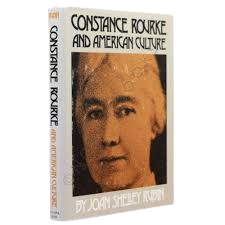
Constance Rourke and American Culture
The career of Constance Rourke (1885-1941) is one of the richest examples of the American writer's search for a ""usable past."" In this first full-length study of Rourke, Joan Shelley Rubin establishes the context for Rourke's defense of American culture -- the controversies that engaged her, the books that influenced her thinking, the premises that lay beneath her vocabulary.
With the aid of Rourke's unpublished papers, the author explores her responses to issues that were compelling for her generation of intellectuals: the critique of America as materialistic and provincial; the demand for native traditions in the arts; the modern understanding of the nature of culture and myth; and the question of a critic's role in a democracy.
Rourke's writings demonstrate that America did not suffer, as Van Wyck Brooks and others had maintained, from a damaging split between ""high-brow"" and ""low-brow"" but was rather a rich, unified culture in which the arts could thrive. Her classic American Humor (1931) and her biographies of Lotta Crabtree, Davy Crockett, Audubon, and Charles Sheeler celebrate the American as mythmaker. To foster what she called the ""possession"" of the national heritage, she used an evocative prose style accessible to a wide audience and depicted the frontier in more abstract terms than did other contempoaray scholars. Her commitment to social reform, acquired in her youth and strengthened at Vassar in the Progressive era, informed her sense of the function of criticism and guided her political activites in the 1930s.
Drawing together Rourke's varied discussions of popular heroes, comic lore, literature, and art, Rubin illuminates the delicate balances and sometimes contradictory arguments underlying Rourke's description of America's cultural patterns. She also analyzes the way Rourke's encounters with the ideas of Van Wyck Brooks, Ruth Benedict, Jane Harrison, Bernard DeVoto, and Lewis Mumford shaped her view of America's achievements and possibilities.
Rourke emerges not simply as a follower of Brooks or as a colleague of De Voto, nor even as an antiquarian or folklorist. Rather, she assumes her own unique and proper place -- as a pioneer who, more than anyone else of her day, boldly and eloquently showed Americans that they had the resources necessary for the future of both art and society. By placing Constance Rourke within the framework of a debate about the nature of American culture, the author makes a notable contribution to American intellectual history.
Originally published in 1980.
A UNC Press Enduring Edition -- UNC Press Enduring Editions use the latest in digital technology to make available again books from our distinguished backlist that were previously out of print. These editions are published unaltered from the original, and are presented in affordable paperback formats, bringing readers both historical and cultural value.
show more
Book Specifications
Book Title
You are viewing an alternative format/edition for this title. You can proceed directly to this book's page to complete your purchase.
More Books By Joan Shelley Rubin
People who bought this also bought

The Hungry Girl Diet Cookbook: Healthy Recipes for Mix-n-Match Meals & Snacks book by Lisa Lillien
The Social Construction of Difference and Inequality: Race, Class, Gender, and Sexuality Book by Tracy E. Ore
Sincerely Yours, Discovering the Treasures of God's Written Word, Volume Five
The Mosaic of Christian Belief: Twenty Centuries of Unity and Diversity book by Roger E. Olson
The China Mirage: The Hidden History of American Disaster in Asia book by James D. Bradley
Boundaries : When to Say Yes, How to Say No, to Take Control of Your Life book by Henry Cloud
Instant Negotiation: Reaching Agreement with Others Now! Book By Brian Clegg
Day-votions for Grandmothers: Heart to Heart Encouragement book by Rebecca Barlow Jordan
The Project Surgeon: A Troubleshooter's Guide to Business Crisis Management
Essentially Speaking: Feminism, Nature and Difference book by Diana Fuss
The Dictator's Handbook: Why Bad Behavior Is Almost Always Good Politics book by Bruce Bueno de Mesquita
Crucial Conversations: Tools for Talking When Stakes are High book by Kerry Patterson
Wealth and Democracy: How Great Fortunes and Government Created America's Aristocracy book by Kevin Phillips
Rules for Radicals: A Pragmatic Primer for Realistic Radicals book by Saul D. Alinsky
The Applause of Heaven: Discover the Secret to a Truly Satisfying Life Book By Max Lucado
Collision with Joy: Glimpses Of Heaven In The Midst Of Loss Book By Melody Richards